Why Tournament Brackets Create Different Routes to a Final
Learn how tournament brackets shape routes to a final by comparing elimination, round-robin, and group-to-knockout formats with one clear example.
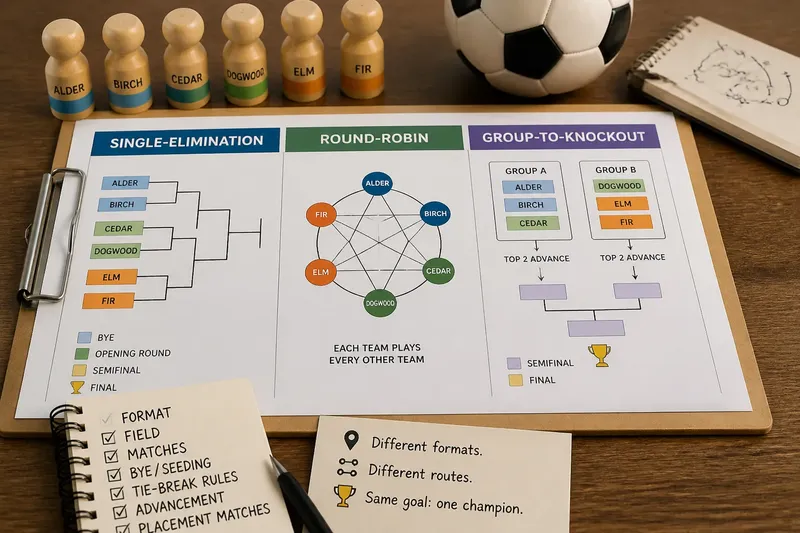
The common mistake when reading a tournament bracket is to assume that every team faces the same route to the final. In a single-elimination bracket, one defeat ends a team’s title route; in a round-robin, a team can remain in contention after a loss. The format changes what a team must do to advance.
To compare formats, follow the same fictional field of six teams: Alder, Birch, Cedar, Dogwood, Elm, and Fir. Imagine that an organizer wants to name one champion and has published the match schedule but not yet explained every tie-break rule.
What should you identify before reading a bracket?
The field is the set of competitors. The format determines which matches are played and how their results affect advancement. A bracket shows some or all of the matchups, but the competition rules also determine matters such as ties and final placement.
A team is eliminated when it can no longer win the title under the published rules. In a knockout bracket, that may happen after a single defeat; in a group stage, it depends on the standings, remaining matches, and qualification conditions.
- If the field has an uneven number of competitors, check how the organizer handles the opening round; then look for byes or another adjustment.
- If teams play different numbers of matches, check why; then identify any bye, late entry, or uneven group schedule before comparing their records.
- If a bracket shows only knockout rounds, check for a separate group or preliminary schedule; then use both sources to trace the full route.
- If teams can finish level in the standings, check the tie-break sequence; then apply the listed criteria in order rather than guessing from the table.
- If a team loses, check whether the rules still allow qualification; then follow its remaining matches and the stated advancement condition.
- If the bracket awards places beyond the champion, check for placement matches; then include those matches when explaining a team’s full schedule.
A bracket is like a transit map: it shows connections between stops, while the rules explain which route a traveler can take and what happens when routes meet.
How does single-elimination shape the route?
In single-elimination, the winner advances and the loser exits the title contest. Each match is a direct fork in the route, and the final determines the champion.
For the six-team field, imagine the organizer gives Alder and Birch opening-round byes. Cedar plays Dogwood, and Elm plays Fir. The two winners then face Alder and Birch in the next round; those match winners meet in the final.
A bye advances a team past a round without a match. It is not a victory unless the competition rules define it differently. The organizer needs to explain how byes are assigned, whether by seeding or another published method, because that decision changes the route.
In this arrangement, a team that plays in the opening round must win three matches to claim the title, while a team with a bye must win two. That difference describes the bracket, not which team is stronger. A single-elimination format creates clear consequences for each match, but it does not show how the same teams might fare in a longer schedule.
What changes in a round-robin competition?
In a round-robin, each competitor plays every other competitor in the group or field. With six teams, Alder’s schedule includes Birch, Cedar, Dogwood, Elm, and Fir. The organizer ranks teams using the published results and tie-break rules.
Alder’s route is a schedule rather than a chain of knockout opponents. A loss does not automatically end its title chances; its standing depends on all its results and, if needed, the tie-break sequence. Schedule order can also affect what teams know when they play, so the fixture list matters alongside the table.
Imagine Alder loses to Birch, then wins against Cedar, Dogwood, Elm, and Fir. The observable result is that Alder remains in the standings after the loss. Whether it finishes first, qualifies for a later phase, or ranks lower depends on the other results and the organizer’s rules.
Before interpreting a round-robin table, find the scoring method and tie-break order. Organizers can choose different criteria, so a reader should not infer how equal records are ranked from the table alone.
How does a group-to-knockout format combine routes?
A group-to-knockout format starts with group standings and sends selected teams into an elimination bracket. The group phase measures results across several matches; the knockout phase makes each match a do-or-exit contest.
Imagine the six teams split into two groups of three: Alder, Birch, and Cedar in one group, and Dogwood, Elm, and Fir in the other. If the top two teams from each group advance, the four qualifiers enter semifinals, followed by a final between the semifinal winners.
Each team in this design has two group matches. A finalist then plays a semifinal and a final. A group-stage loss does not necessarily end a team’s campaign, but a semifinal loss ends its route to the title.
Say Alder loses to Birch, beats Cedar, and finishes second in its group. Under the stated rule that the top two advance, Alder reaches a semifinal. If it wins that match, it reaches the final; if it loses, its title route ends. The example shows why the consequences of a loss depend on the phase.
Group assignment and the number of qualifying teams also shape the route. If the qualifying field does not fit the knockout bracket, the organizer must explain any bye or other adjustment. A reader needs those details rather than relying on the label “tournament.”
How do the formats change a team’s route?
Single-elimination quickly narrows the field, round-robin standings reflect results across a schedule, and group-to-knockout combines both structures. These formats make different trade-offs in match sequence, direct meetings, and the consequences of a defeat.
- Single-elimination: follow each match winner; a defeat ends the title route.
- Round-robin: follow the standings; a team’s position depends on its full schedule and the tie-break rules.
- Group-to-knockout: follow the group table and then the bracket; a defeat has different consequences in each phase.
To compare two routes, identify each team’s matches, mark where it can be eliminated, and check whether every competitor meets the same opponents. Then look for byes, carried-over rankings, and the point at which a later round begins. These details explain what the format permits without claiming that it identifies the strongest team in every possible contest.
What should you check when a tournament bracket is unclear?
Does a bye count as a win?
A bye advances a competitor without a match, so do not record it as a victory unless the rules specify that treatment. Check the standings or scoring rules to see how the bye is recorded.
Can a team lose and still reach the final?
In single-elimination, a defeat ends the title route. In a round-robin or group stage, a team may remain eligible, depending on its standing and the qualification rules.
Why can teams with equal records rank differently?
The organizer applies tie-break rules to order teams whose main records are equal. Check the published sequence, since the chosen criteria and their order can differ between competitions.
Does a bracket show every match a team plays?
Not always. A knockout diagram may omit group matches, preliminary rounds, or placement games, so compare it with the full schedule and format rules.
How can you describe a tournament route accurately?
Name the phase, the advancement condition, and what a defeat means. For example: “Alder must finish among the top two in its group to qualify; then it must win the semifinal to reach the final.” This states the route without predicting a matchup or result.
If the rules do not show how teams are seeded, how ties are settled, or how byes are assigned, say that the bracket image alone does not settle those questions. The search phrase tournament brackets describes the diagram, but understanding a route also requires the format and schedule.
Return to Alder to compare the three structures: a knockout loss ends its title route, a round-robin loss leaves its standing to be determined, and a group-stage loss may still allow qualification. That distinction helps readers see what a bracket tells them—and what they still need to check in the rules.