Why the Volleyball Net Sets the Shape of the Game
Understand how the volleyball net shapes contacts, attack angles, blocking and court position so rallies make sense from serve to final touch.
The most common mistake when watching volleyball is to treat the net as a line that merely separates two teams. It costs you the logic of the rally: the net dictates which contacts are legal, where attackers can send the ball and how defenders arrange themselves. The volleyball net is the game’s central constraint, not just its boundary.
What does the net divide in volleyball?
The net divides the court into two playing areas, one for each team. Players may not reach across it to interfere with an opponent’s play, and the ball must cross above the net into the other court during ordinary play. That simple division creates a contest in which each side builds an attack on its own half and tries to make the ball difficult to return on the other.
The net also marks the front and back portions of each court. The attack line, drawn parallel to the net, separates the front zone from the back zone. This line matters because a back-row player may attack from behind it, but cannot complete an attack from the front zone when the ball is entirely above the top of the net.
Think of the net like the counter between two cooks: it keeps each person on a side, but the work is still connected by what passes across it. In volleyball, the ball is that shared object, and every crossing changes which team must act.
Why do teams usually use three contacts?
A team can touch the ball up to three times before sending it over, and a block touch does not count as one of those team contacts. The familiar sequence is reception, set and attack, though teams can send the ball across earlier if the play calls for it. The limit gives a team room to control the ball and build an attack without letting it keep possession indefinitely.
The first contact often turns a serve or attack into a playable ball. The second contact, commonly a set, places the ball for a hitter. The third is often a spike, tip or controlled shot intended to create a difficult return. These roles are common patterns, not a requirement that each contact be made by a different player.
For example, imagine a serve dropping toward a receiver who passes it accurately to a setter near the net. The setter sends a high ball to an outside hitter, who aims past the opposing block into an open area; the visible result is a coordinated attack rather than a rushed free ball.
How does net height change the attack?
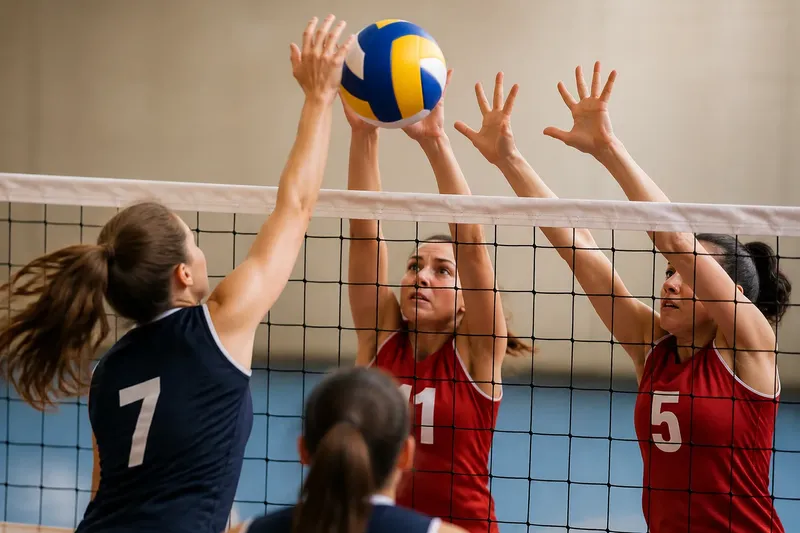
The net makes vertical reach part of the contest. A hitter who contacts the ball above the net can direct it downward into the opposing court, while a defender near the net can jump to block that path. Height alone does not decide the rally, though: the attacker can alter timing, angle, speed or direction to avoid a well-positioned block.
Net height differs by competition category and division. The official setup for a match should be checked against the rules that govern that event, because the height is not identical across all formats. For a viewer, the useful point is that the net’s top is the reference line for attacks and blocks, not a mark that every legal ball must clear by a large margin.
A serve or attack that touches the net may still be playable if it crosses into the opponent’s court within the rules. The net is therefore an obstacle, but not always an automatic end to the rally. Its effect depends on where the ball goes after contact.
Why does court position matter near the net?
Front-row players can attack close to the net and form the main block, while back-row players cover deeper areas and can attack under the restrictions tied to the attack line. Each team’s rotation changes which players occupy those roles, so a player’s position in the lineup affects what they may do at the front.
Position also shapes the angles available to an attacker. A hitter near the sideline can send the ball down the line or diagonally across court; a hitter closer to the middle has a different set of openings. The defenders read the approach and setter’s choices, then shift to cover likely routes without leaving other spaces exposed.
The setter’s location matters because a ball set too far from the net can reduce the attacker’s available downward angle, while a set too tight can make the attack vulnerable to a block or create a net fault. A setter balances distance, height and timing so the hitter can contact the ball at a useful point.
What happens when the ball or a player touches the net?
A ball may touch the net while crossing and remain live if it passes over and lands legally in the opponent’s court. By contrast, a player’s contact with the net during the action of playing the ball can be a fault. The distinction is between the ball interacting with the net and a player interfering with play through net contact.
Players may reach over the net to block an opponent’s attack, but they cannot reach across to play the ball before the opponent has made an attack hit that permits the block. This prevents a blocker from taking away the other team’s chance to complete its play. On the other hand, a player may follow through across the net after a legal attack if the action does not interfere with the opponent.
Exact decisions can depend on the competition’s rules and the moment of contact. When a disputed play matters, the referee’s signal and the governing rules for that event are the useful references; a brief brush of the net is not enough on its own to explain every call.
How do players read the net during a rally?
Players use the net as a reference for timing, spacing and risk. A setter watches the hitters’ approaches and the blockers’ hands; an attacker judges whether to hit hard, roll the ball into open court or tip it over the block. Defenders track the likely crossing point and prepare to move as the ball clears the net.
That reading is not just visual. Players coordinate through calls, approach rhythms and familiar patterns, because a hitter who arrives late may contact the ball too low or collide with a teammate. The net gives both teams a shared landmark around which those movements are organized.
Which net questions do new viewers ask?
Can the ball touch the net on a serve?
Yes, a serve that touches the net and still crosses legally into the receiving court remains in play. If it fails to cross or lands outside the legal area, the serve is a fault.
Can a player reach over the net to block?
A blocker can reach across when the opponent has made an attack hit, subject to the rules that govern the block. Reaching over earlier to take the ball away from the opponent’s developing play is not permitted.
Can a back-row player attack at the net?
A back-row player may jump and attack, provided the player takes off from behind the attack line when the ball is entirely above the net at contact. The player may land in the front zone after the attack.
Does a net touch always stop the rally?
No. A ball can touch the net and continue if it crosses legally, while a player’s net contact may be a fault when it occurs during an action of playing the ball. The referee applies the relevant rule to the specific contact.
What should a viewer watch on the next rally?
Follow the ball’s path in relation to the net, then notice where the setter sends it and how the blockers respond. Watch whether the hitter attacks over or around the block, and whether the back-row defenders have moved to cover the likely landing area. Those details reveal how a team turns its three contacts into pressure.
The volleyball net shapes the game because it links rules to movement: it separates the sides, limits the attack and gives every player a reference for height and position. Once you read it as an active part of the rally, a fast exchange becomes easier to follow—not because every ball is predictable, but because you can see what each side is trying to do before the ball crosses.