Man-to-Man and Zone Defense: How Teams Share the Space
Man-to-man and zone defense assign attention differently. See what defenders watch, how the choice shapes team movement, and why neither scheme fits every moment.
The most common mistake when comparing man-to-man and zone defense is to treat one as a mark of effort and the other as a shortcut. That confusion makes it harder to see what defenders are actually responsible for: an opponent, a patch of space, or a changing combination of both. The distinction is useful across court and field sports, though the rules and details vary.
What does each defense ask players to watch?
In man-to-man defense, each defender is primarily responsible for an assigned opponent. The assignment may change after a screen, switch, or other team decision, but the defender’s attention begins with that player: where they are, what they can do next, and whether they are moving toward a dangerous area.
Zone defense divides the playing area into responsibilities. A defender watches opponents who enter their assigned space, while also tracking nearby movement and communicating with teammates. “Zone” does not mean ignoring opponents; it means responsibility is organized around areas rather than one fixed matchup.
Think of man-to-man as carrying a particular shopping bag through a busy store, while zone is keeping an eye on a particular aisle. In either case, you still notice what is happening around you; the difference is what anchors your attention.
How does the choice change a team’s movement?
In man-to-man, defenders often move in response to their assigned opponents. If an opponent cuts across the court, the defender may follow, pass the assignment to a teammate, or switch according to the team’s plan. Teammates must stay aware of these changes so that a brief movement does not leave someone free.
In a zone, defenders shift together as the ball moves and opponents enter or leave their areas. A player may step toward the ball while a teammate covers the space behind. This calls for communication and coordinated spacing: if the group shifts late or unevenly, an opening can appear between responsibilities.
Neither scheme makes movement simple. Man-to-man can demand sustained attention to an opponent who changes speed or direction; zone can demand constant awareness of the ball, nearby attackers, and teammates’ positions. The effort is directed differently.
What happens in one hypothetical game situation?
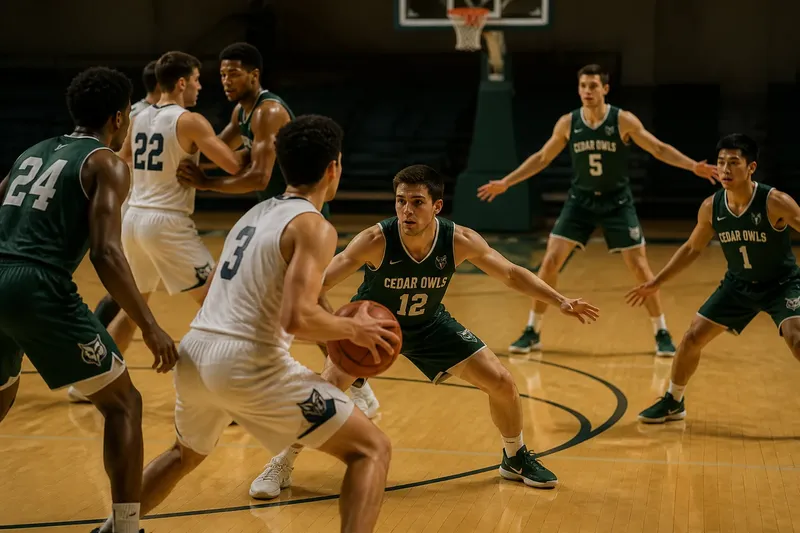
Say a fictional basketball team, the Cedar Owls, is defending a close game. Their opponent has a strong ball-handler near the top of the court, two teammates spaced wide, and a tall player moving toward the basket. The Owls begin in man-to-man, with each defender matched to an opponent.
The ball-handler uses a screen from the tall player. The defender guarding the ball-handler has to decide whether to follow around the screen, switch assignments with the defender guarding the screener, or get help briefly while recovering. Each choice has a cost: following can leave the ball-handler room, switching can create a less favorable matchup, and help can free another opponent.
Imagine the Owls instead choose a zone for the next possession. The nearest defender steps toward the ball, while another takes responsibility for the area the ball-handler is approaching. A third watches the movement toward the basket and calls out the cutter. The defenders are not simply standing still; they are handing attention across spaces as the play develops.
In this invented situation, the ball-handler passes wide. The zone shifts toward that side, and the player moving toward the basket enters another defender’s area. If the call and shift are timely, the receiver sees a defender closing space and the cutter finds the route less clear. If the defenders do not communicate, the pass or cut may reach an uncovered area. In man-to-man, the corresponding result depends on whether the assigned defenders handle the screen and any switch as intended.
The lesson is not that one defense stops this play. It is that each asks players to solve a different coordination problem: preserve individual matchups while navigating screens, or transfer responsibility smoothly as the ball and attackers move through shared space.
When might a team prefer one approach?
A team may choose man-to-man when it wants defenders to stay closely connected to particular opponents or believes its players can manage the matchups and movement. It may also make it easier for a viewer to track who is responsible for a prominent attacker, although switches can blur that picture.
A team may use a zone to protect certain areas, encourage opponents to take a different kind of shot, or reduce the need for one defender to follow a particular player everywhere. The tradeoff is that opponents may try to exploit gaps between zones, move the ball quickly, or position players where responsibility is uncertain.
Coaches can change schemes during a game, and teams can combine principles. A defender in man-to-man may help when an opponent drives, then recover to their assignment; a zone may briefly match a player’s movement before passing that responsibility onward. The names describe the organizing idea, not every action on every possession.
What should a viewer look for in man-to-man and zone defense?
How can I spot man-to-man defense?
Watch whether defenders generally move with particular opponents, especially when those opponents cut away from the ball. A switch may change who guards whom, so look for the defenders’ response rather than expecting one pairing to stay fixed.
How can I spot a zone?
Notice whether defenders shift toward the ball while maintaining rough responsibility for areas. An attacker may move through the court without one defender following the entire route, as attention is passed among nearby players.
Why do defenders call out during a possession?
Calls can signal a screen, a cutter, a switch, or a teammate who needs help. The communication makes shared responsibility visible: players need to know not only what they see, but what their teammates are covering.
Can a team use both kinds of defense?
Yes. Teams can change schemes between possessions or blend responsibilities within a possession, depending on their plan and the rules of the sport. Watch the defenders’ movement and handoffs of responsibility rather than relying only on the label.
How can the two approaches be compared fairly?
Ask three questions as the play unfolds: Who is each defender watching? What happens when an attacker crosses into a new area? How quickly do teammates respond when the first defender is screened or beaten? Those questions reveal the underlying assignment without assuming that every player is following a strict version of a scheme.
Also distinguish a tactical choice from its execution. An uncovered attacker may reflect a missed call, a late rotation, or a poor matchup decision; that single outcome does not explain the whole defense. Likewise, a contested shot does not by itself show which approach was better suited to the situation.
Man-to-man and zone defense are two ways to organize attention, not a ranking of commitment. To understand either, follow the responsibility: the opponent a defender tracks, the space a defender protects, and the moment teammates pass coverage between them. That is the clearest way to read how a team shares the space.